

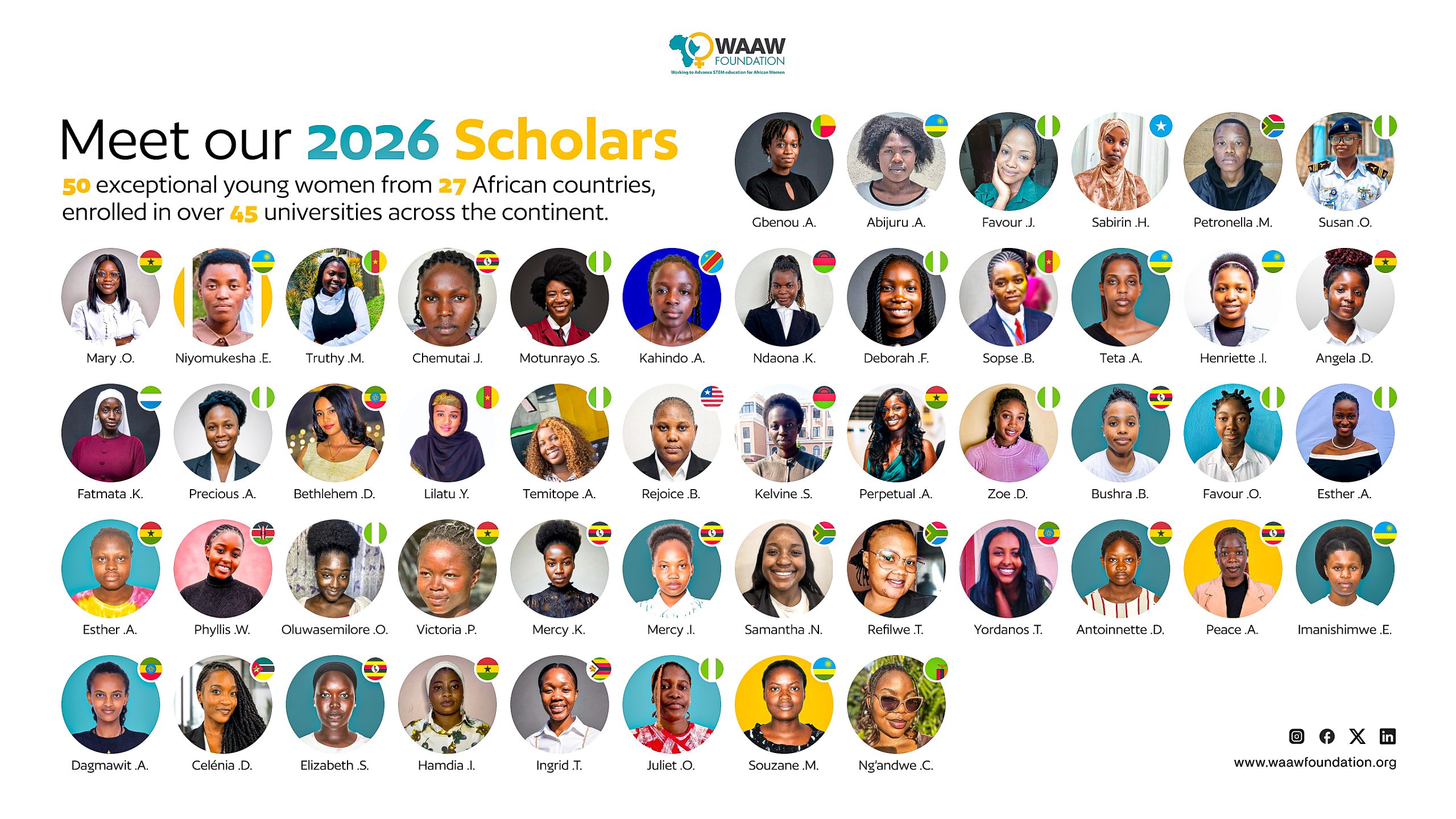
50 African Women In STEM: Presenting the 2026 WAAW Foundation Scholars
30,000 secondary school students across Africa are about to walk into a classroom and see a mentor who looks exactly like them.
They won’t just see an instructor writing equations on a blackboard; they will see a software developer, a biomedical researcher, a mechatronic specialist, and a structural architect. They will see women who have looked systemic limitation in the eye, refused to blink, and are now reaching back to pull the next generation through the door.
This is the real weight behind the numbers. When we talk about selecting our 50 WAAW Foundation Scholars for 2026, it’s easy to get lost in the metrics. It’s easy to focus solely on the high-level university programs, the certificates, or the sheer volume of the selection pipeline. But the metrics are just the scaffolding. The human impact is the actual building.
To understand how we got to these 50 extraordinary women, you have to look at the massive, continent-wide wave they had to ride.
The Great African Tech Surge
This year, a staggering 1,122 brilliant young women from 27 different African nations put their dreams down on paper and applied for the WAAW scholarship. The raw data tells a story of an unstoppable hunger for STEM education that spans across every region of the continent:
| Country | Active Chapter Presence? | Applicants |
| Nigeria | Yes | 343 |
| Kenya | Yes | 46 |
| Ghana | Yes | 83 |
| Rwanda | Yes | 377 |
| Uganda | Yes | 17 |
| South Africa | New Frontier | 112 |
| Cameroon | Yes | 10 |
| Somalia & South Sudan | New Frontier | 16 (Combined) |
From countries with deep, established WAAW roots like Nigeria and Rwanda to emerging technological frontiers like South Africa where 112 independent applicants raised their hands without a single existing local chapter—the message was unanimous: African women are ready to build the future.
Reviewing these 1,122 applications wasn’t a standard corporate screening process; it was an emotional, humbling journey through the realities of the African educational landscape.
We read stories from girls who faced prolonged two-year financial gaps after secondary school, watching their brothers get sent to classes while they were kept back to manage households or prepare for early marriages. We reviewed files from young women whose mothers work tirelessly as nannies or small-scale farmers just to buy standard reference manuals. We saw applications from war-torn or underserved regions like South Sudan and Somalia, where studying computer science isn’t just an academic choice—it is an act of pure, defiant resilience.
Out of that ocean of raw talent and staggering determination, 50 trailblazers emerged.
Meet the Builders of Tomorrow
The 50 scholars stepping into the WAAW cohort this year represent the absolute pinnacle of problem-solving innovation. They aren’t waiting for graduation to create change; they are altering reality right now, using whatever resources they can get their hands on.
-
The Eco-Innovators: Look at Abijuru Afissa in Rwanda. While others saw agricultural post-harvest banana losses as a waste management crisis, Afissa engineered a green social venture that upcycles banana peels into eco-friendly liquid soap, shoe polish, and nutritious biscuits, single-handedly creating local jobs for youth and women.
-
The System Stabilizers: Consider Angela Dumoga in Ghana, who survived years of financial stagnation to pull an incredible 4.26 GPA in Chemical Engineering, dreaming of combining heavy-tech plant design with a future law degree to protect vulnerable communities from industrial exploitation.
-
The Digital Architects: Look at Phyllis Wanjiku in Kenya or Antoinnette Dugbley in Ghana, who both looked around their respective campuses, saw female technical isolation, and independently founded coding clubs (SHECODES/TECH) and grassroots secondary school mentorship panels to prove that tech is not a “boys’ club.”
-
The Heavy-Tech Pioneers: From Susan Odia, breaking records as the Most Outstanding Female Cadet in Marine Engineering at the Nigeria Maritime University, to Deborah Fashida, chasing a childhood dream sparked by Formula 1 to pioneer mechatronics literacy through her initiative.
The Blueprint for Continental Transformation
The WAAW Foundation Scholarship is not a philanthropic handout or a one-time reward. It is a strategic investment in ecosystem builders.
Every single one of these 50 selected women is being equipped with more than tuition coverage. They are receiving rigorous leadership advancement and an unshakeable pan-African sisterhood of mentors and alumnae.
Why? Because the condition of this scholarship is action.
These 50 women are now certified change agents. They are returning to their universities and their immediate local communities to set up STEM Chapters, run interactive STEM outreaches, and anchor development right from within their home base. They are the ones who will stand in front of those 30,000 secondary students and serve as living, breathing proof of what is possible.
To the 1,072 applicants who didn’t make the final cut this year: Do not put your vision on pause. The sheer brilliance of your applications proved that the talent cap on this continent does not exist. You are part of this movement, and your communities still require your engineering mindsets.
To our 50 new WAAW Scholars: Welcome to the vanguard. The tools are in your hands, the network is behind you, and 30,000 African children are waiting to see who you become.
Let’s build.
Become a Pillar: Support an African Girl in STEM
Behind every statistic is a girl waiting for her chance to disrupt the status quo.
When you look at the 1,072 young women who didn’t make this year’s cohort—not because they lacked brilliance, but because resources are finite, the structural gap becomes clear. The hunger for STEM education across the continent is vastly outpacing the current infrastructure.
We can change that, but it requires collective leverage.
By partnering with WAAW Foundation, you aren’t just funding a certificate; you are anchoring a localized chain reaction. Your support gives a brilliant young woman the financial clearance to stay in the laboratory, master advanced architectures, and step into a secondary classroom to mentor 600 more girls who are watching her every move.
You don’t have to look far to see what happens when African women are given the tools to build. They engineer green social ventures, design smart city frameworks, and protect networks. They rewrite the baseline of their communities.
Let’s make sure the next 1,122 hands raised don’t have to be put on pause.