
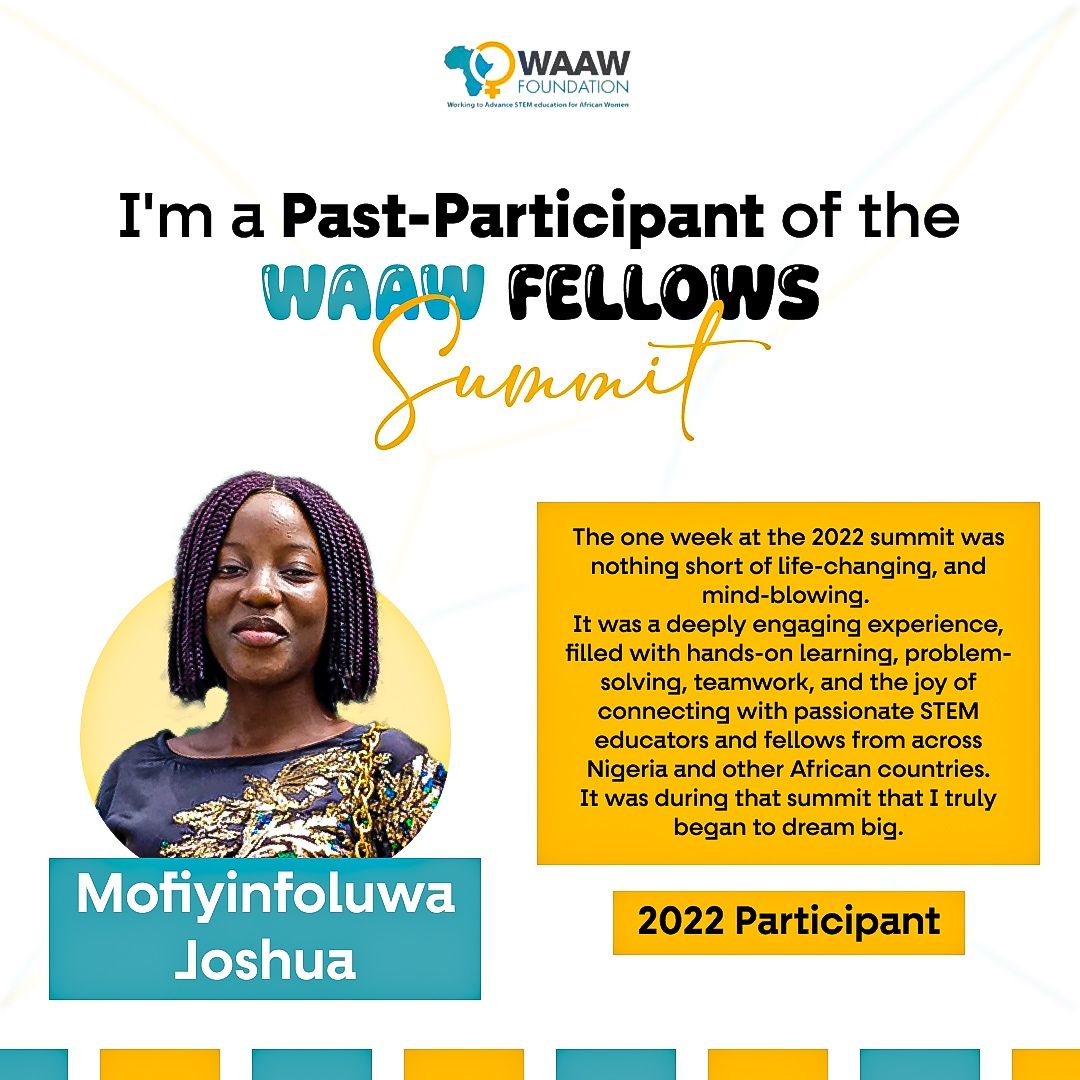
The Mofiyinfoluwa Story: 2022 WAAW Foundation Summit Participant
Mofiyinfoluwa’s path to becoming an Electrical & Electronics Engineering graduate wasn’t straightforward. Her story demonstrates exactly why targeted investment in African women pursuing STEM careers produces measurable results—and why the WAAW Foundation’s approach works.
The Financial Reality
When Mofiyinfoluwa applied for the WAAW scholarship in 2021, her situation was dire. Her father refused to spend money on his daughters’ education, believing females weren’t worth the investment. Her mother had sacrificed her own education, diverting her school fees to support seven children. By the time Mofiyinfoluwa reached university age, the financial strain had reached a breaking point.
“There are unpleasant situations in my life, enough to set me off the track of fulfillment, which are most times rooted in poor finances,” she wrote in her application. “My mother, who single handedly provides quality education for her seven kids, couldn’t guarantee me a smooth academic journey without the mercy of a scholarship.”
This isn’t unusual. Across Africa, talented young women face identical barriers—family financial crises, gender-based educational discrimination, and lack of access to STEM resources.
Early Technical Aptitude
Despite these obstacles, Mofiyinfoluwa had already demonstrated technical capability. At age six, she was building simple circuits and lighting up her dollhouse. By the time she was present at every domestic electrical work project at home, her interest in electrical engineering was clear.
“I’ve always been interested in how electricity works, as young as age 6 I would build my own simple circuits and light up my doll’s house and accumulate spoilt toys or LEDs to make the best I could in my own little way,” she explained.
Her technical curiosity was matched by understanding of broader impact. She recognized that female education drives economic growth, increases GDP, and reduces poverty rates. “The more females educated, the lesser the rate of poverty, and higher the standard of living in most especially developing countries,” she wrote.
Immediate Community Impact
Even while struggling financially, Mofiyinfoluwa was already teaching and mentoring others. She tutored primary school children during summer breaks and taught at a primary school after completing secondary education. Her students’ exceptional performance in common entrance examinations brought recognition from parents.
She also volunteered with Teen Girls Enlightenment Initiative (TGEI), focusing on academic excellence, menstrual hygiene, and teen pregnancy prevention. This work generated what she called “a tremendous sense of achievement and fulfillment.”
The WAAW Foundation Intervention
WAAW Foundation made Mofiyinfoluwa a scholar in 2021. She was selected for the 2022 Fellows Summit. The results were immediate and measurable.
By 2023, she had graduated with her Electrical & Electronics Engineering degree. She secured a 60% scholarship for Robotics Development and Automation studies. She continued taking additional courses to advance her technical skills.
More importantly, she became a mentor and pathfinder for other young women in STEM.
Measurable Outcomes
Mofiyinfoluwa’s transformation produces quantifiable results:
- Educational Achievement: Bachelor’s degree completion in Electrical & Electronics Engineering
- Continued Learning: 60% scholarship for advanced robotics studies
- Teaching Impact: Improved test scores among students she tutored
- Mentorship Role: Active guidance for next generation of STEM students
- Professional Development: Ongoing skills advancement in emerging technologies
The Multiplier Effect
This is how strategic investment works. One scholarship recipient becomes a teacher, mentor, and professional who lifts others. Mofiyinfoluwa didn’t just receive education—she immediately began providing education to others.
Her technical skills, combined with her understanding of systemic barriers, make her exactly the kind of leader Africa needs in STEM fields. She breaks stereotypes while building practical solutions.
The 2025 Summit Investment
This August, WAAW Foundation hosts its 2025 Fellows Summit in Nairobi, Kenya. The investment required is specific and targeted:
- $14,000: Travel expenses for 50 WAAW fellows from 10 East African countries
- $5,500: Accommodation for summit participants (5 days)
- $5,400: Meals for all participants
- $2,800: STEM kits, training materials, and resources
- $500: Field visit expenses
- $500: Logistics and operational costs
Total investment: $28,700 to transform 50 young women’s careers and create the next generation of African STEM leaders.
Why This Model Works
Mofiyinfoluwa’s story demonstrates three key principles:
- Early identification: Technical aptitude appears early and can be recognized
- Strategic intervention: Financial support at the right moment removes barriers
- Immediate multiplication: Recipients become providers, expanding impact exponentially
The return on investment is clear. Every WAAW scholar becomes a teacher, mentor, and professional contributing to Africa’s technological advancement.
The Bottom Line
Mofiyinfoluwa went from writing “I beseech the WAAW Scholarship to grant me financial aid… which I’m in dire need of” to becoming an engineering graduate pursuing advanced robotics studies.
She went from being taught to teaching others. She went from receiving support to providing support. She went from facing barriers to breaking them down for others.
This transformation cost one scholarship. The impact reaches dozens of students she’s taught, peers she’s mentored, and communities she’ll serve as a STEM professional.
Fifty more young women at the 2025 Nairobi summit represent 50 potential Mofiyinfoluwas. The total investment is $28,700. The potential return—in terms of technical innovation, educational impact, and economic development—is immeasurable.
The WAAW Foundation model works because it’s simple: identify talent, remove barriers, provide support, then watch as recipients become providers.
Support the 2025 WAAW Fellows Summit. Transform lives. Build Africa’s STEM future.