

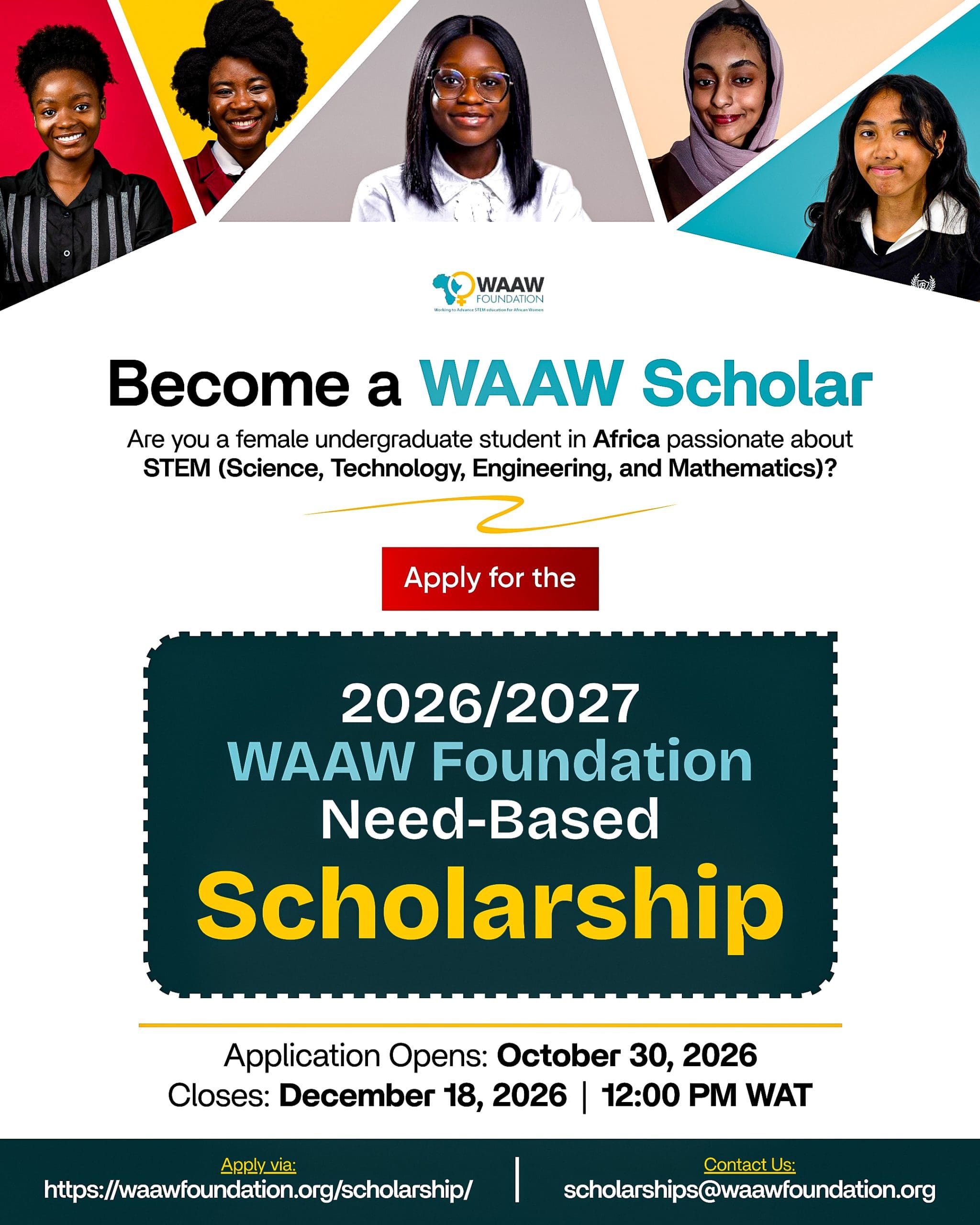
Applying for the 2026/2027 WAAW Foundation Scholarship: Who We’re Looking For and How to Answer the Questions
Applications for the 2026/2027 WAAW Foundation Need-Based Scholarship are open, and we want to help you put your best foot forward. Every year we read applications from brilliant young women who are doing remarkable things, and some of them undersell themselves simply because nobody told them what we’re looking for or how to say it. This post covers both.
Who we’re looking for
The scholarship is for female students of African origin who live and study in Africa. Beyond that, you should:
- Be currently enrolled in a Bachelor’s degree program
- Be studying a STEM-related course at a university or college in Africa
- Be a first or second year student, or a third-year student on a 5-year course
- Be able to demonstrate financial need
- Have an excellent academic record
- Have a proven record of leadership, volunteering, and community service
- Be below the age of 32
Read that list properly before you start, because it tells you what the committee will be looking for in every answer you write. Financial need and academic strength get you into the conversation, but leadership and community service show us what you’ll do with the opportunity. WAAW scholars are expected to mentor secondary school students through our College-to-Secondary program, so we’re looking for women who are already in the habit of pulling others up.
How to answer the questions
The application has five questions, and four of them have a 300-word limit. That isn’t much room, so every sentence has to earn its place. A few things apply to all of them:
- Write like a person, not a brochure. We can tell when an essay was written to impress and when it was written to be honest.
- Be specific. “I am passionate about community development” tells us nothing, but “I started a weekly revision class for 12 JSS students in my neighbourhood” tells us a lot.
- Show, don’t claim. Don’t tell us you’re a leader. Describe what you did and what changed because of it.
- Write your own story. Your situation is the only thing nobody else can write for you.
1. What is your proudest achievement to date? (300 words)
We’re not necessarily looking for the biggest achievement. We’re looking for one that shows who you are. It could be an award, a project you led, a grade you fought hard for, or something you built with very little.
A simple structure that works well:
- The situation: What was the problem or challenge?
- What you did: Your actions, in first person. Say “I,” not “we,” even if it was a team effort. Tell us your part.
- The result: What changed? Numbers help if you have them (people reached, money raised, grades improved), but a clear before and after works too.
- What it taught you: One or two sentences on how it shaped you.
The most common mistake is picking an achievement that sounds impressive but that you can’t talk about with any detail. Choose the one you can describe vividly.
2. What are your future career goals and how do you expect the WAAW Foundation scholarship to help you fulfil them? (300 words)
This question is really two questions, and a lot of applicants only answer the first. Give both equal weight.
For the career goals, be concrete. “I want to be an engineer” is a start, but what kind of engineer, solving which problems, for whom? If you can connect your goals to a real challenge in your community or country, do it.
For the scholarship, be honest about the connection. How does funding, mentorship, and being part of the WAAW community move you closer to that goal? Think about what’s actually in the way right now, whether that’s tuition, learning materials, internet access, or not having someone to guide you, and how this changes it.
It also helps to mention how you plan to give back. Mentorship is a core part of this scholarship, so telling us how you’d use your position to support younger girls shows you understand what WAAW is about.
3. What do you believe about female education in Africa and its impact on research, development, or the advancement of African economies? (300 words)
This is your chance to show you can think, not just recite statistics. You don’t need to pull in a pile of numbers. A clear position, backed by one or two examples, is stronger than a list of facts.
Start with what you believe. Then support it with something you’ve seen or experienced yourself: a girl in your community who dropped out, a lecturer who changed how you saw your field, or a gap you noticed in your own department. Connect that to the bigger picture of what happens to research, innovation, and the economy when women are left out, and what changes when they’re included.
Avoid generic lines about how “educating a girl educates a nation.” You can believe it, but we want to see how you got there.
4. Tell us about your need, or your personal, family, or financial situation, and how the funds will assist your education and/or career plans. (300 words)
This is often the hardest question to write, and the one where people are tempted to either say too little or exaggerate. Please do neither.
Be honest and be specific. Tell us about your family situation, who pays for your education now, and what has happened when funding has been difficult. If you’ve had to defer, borrow, skip meals, or study without the materials you need, say so plainly. You don’t need to dramatise it. The facts are enough.
Then be clear about what the funds would change. Be as specific as you can about what the money would cover and what that would make possible for you.
Keep in mind that financial need is only one of the barriers many students face. If infrastructure, family pressure, or lack of mentorship is part of your story, include it here.
5. Any other information that supports your application
This is where you list the things that didn’t fit elsewhere: projects, extracurricular activities, volunteering, awards, scholarships or fellowships you’ve held, and leadership roles. Include dates. The question specifically asks for them, and they help us see your timeline.
A clean list works best here, ordered with the most relevant or recent first. For each item, give the name, your role, the date, and one line on what you did or achieved. If you’ve served in a student chapter, led a club, tutored, volunteered in your community, or taken part in a competition, this is the place for it.
A few last tips before you submit
- Write in a separate document first. Draft your answers somewhere you can edit them, check the word count, and then paste them into the form.
- Read it out loud. If it doesn’t sound like you, rewrite it.
- Ask someone to read it. A friend, lecturer, or mentor can spot gaps you can’t see.
- Don’t wait until the last day. Technical problems and slow internet are real, and we don’t want a good application lost to a bad connection.
- Check your eligibility one more time. Re-read the list above and make sure you meet every point before you apply.
We receive applications from across the continent, and we can only fund a small number of them each year. That has nothing to do with how deserving the rest of you are. The best thing you can do is tell your story clearly and honestly, and let us see the woman behind the grades.
Ready to apply? Start your application here | Deadline: December 18th, 2026, at 12:00 PM WAT
Questions about eligibility or the process? Reach us at scholarships@waawfoundation.org.